Leather Bag MOQ: What Brands Need to Know Before Production
Minimum order quantity is one of the very first questions most brands ask a manufacturer, and one of the most misunderstood. MOQ isn't a single fixed number that applies to every product a factory makes. It shifts depending on materials, customization, hardware, and how many different styles you're producing at once.
This guide breaks down what actually determines MOQ, so you can plan a realistic first production run instead of guessing.
Table of Contents
- What MOQ Actually Means
- Per Style vs Total Order
- Material MOQ
- Hardware MOQ
- Custom Color MOQ
- Logo and Embossing MOQ
- Packaging MOQ
- How Sampling Differs From Production
- How to Reduce Initial MOQ Risk
- FAQ
What MOQ Actually Means

MOQ is the smallest quantity a manufacturer will produce in a single order. It exists because certain costs, like setting up cutting patterns, ordering material in bulk, or configuring custom hardware, only make financial sense above a certain volume. Below that threshold, the manufacturer would be producing at a loss.
What often surprises brands new to manufacturing is that MOQ isn't one number. It's the sum of several smaller thresholds that can each apply differently.
Per Style vs Total Order
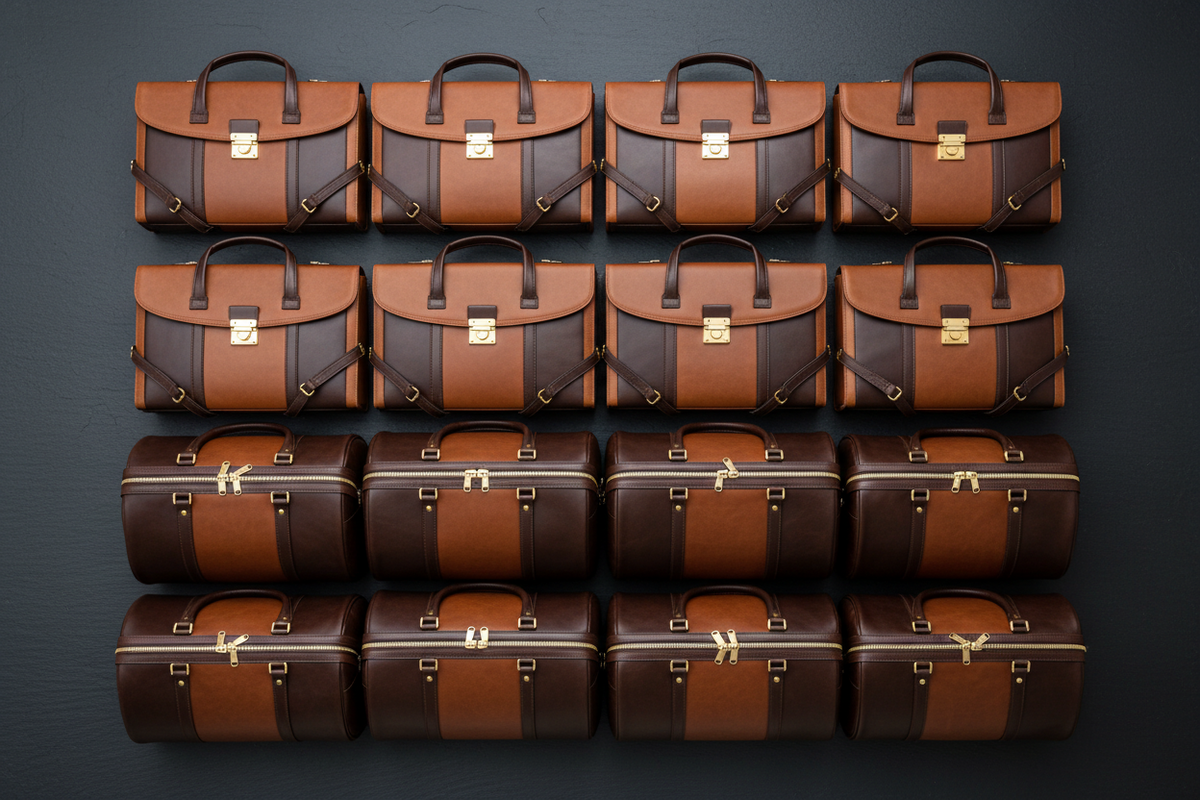
Some manufacturers set MOQ per individual style. Others allow you to combine multiple styles to reach a single total order minimum, as long as they share the same material and construction base. This distinction matters enormously for a first order. A brand launching three bag styles might struggle to hit MOQ on each one individually, but could comfortably reach a combined total minimum across all three.
Always clarify which type of MOQ you're being quoted before assuming your production plan is feasible.
Material MOQ
Leather is typically purchased by the manufacturer in bulk, and suppliers often have their own minimum order requirements for a given hide, color, or finish. If you're requesting a leather that isn't already part of a manufacturer's standard stock, expect the material minimum to be a separate, often higher, threshold than the finished product MOQ.
Hardware MOQ
Standard hardware, zippers, buckles, D-rings in common finishes, usually carries a low or negligible minimum, since manufacturers keep it in regular stock. Custom-finished hardware, such as a proprietary plating color or a branded zipper pull, is a different story. Custom hardware often requires its own tooling or a dedicated production run from the hardware supplier, which can meaningfully raise your effective MOQ. This kind of customization tends to come up more in OEM projects than private label ones. See our comparison of OEM vs private label leather goods for how that affects your production plan.
Custom Color MOQ
Requesting a custom-dyed or custom-finished leather color, rather than selecting from a manufacturer's existing palette, typically triggers its own minimum. Tanneries generally need a minimum hide quantity to justify running a custom dye batch. If a specific brand color is essential from day one, factor this into your production plan early. Material choice affects this too: see our guide on full-grain vs top-grain leather for how grade selection ties into custom color and sourcing.
Logo and Embossing MOQ
Logo embossing tooling is a one-time cost, but the manufacturing time it takes to set up and run an embossing die efficiently often means there's a practical minimum quantity below which the branding cost per unit becomes disproportionate. Confirm this cost and threshold before committing to a custom debossed or embossed logo on a small first order.
Packaging MOQ
Custom printed boxes, branded dust bags, or printed inserts typically carry their own separate minimums, often set by the packaging supplier rather than the leather manufacturer itself. A generic dust bag or box may be available at low quantities, while a fully custom printed version usually requires a larger commitment.
How Sampling Differs From Production

It's worth being clear that sampling and bulk production are governed by entirely different rules. Sampling is typically handled separately from the bulk production MOQ, allowing brands to approve a design before committing to a production run. MOQ applies once you move from sampling into the actual bulk order.
How to Reduce Initial MOQ Risk
The most practical way to lower MOQ risk on a first order is to reduce the number of variables you're asking a manufacturer to accommodate simultaneously. A smaller number of styles, standard hardware finishes, and an existing leather color from the manufacturer's palette will almost always bring your effective MOQ down compared to a first order that combines multiple custom requests at once. Many brands successfully launch with a focused first collection, then expand customization once volume justifies it.
Wondering what MOQ actually applies to your product?
Your actual MOQ depends on the specific product, materials, and customization involved, which is exactly why it's worth discussing directly. Obi Pelle works with brands worldwide to find a realistic first production plan. Discuss your project with our team →
FAQ
Is MOQ the same for every leather bag manufacturer? No. MOQ varies significantly by manufacturer, and within a single manufacturer, it varies by material, hardware, color, and customization requested.
Can I combine multiple styles to reach a manufacturer's MOQ? Sometimes. Some manufacturers allow combined totals across styles sharing the same material and construction, while others set MOQ per individual style. Always confirm which applies.
Does a custom logo always require a higher MOQ? Custom embossing or debossing tooling often has a practical minimum quantity, though this varies by manufacturer and branding method. It's worth asking directly rather than assuming.
What's the easiest way to lower my first order MOQ? Reduce the number of custom variables in your first order, fewer styles, standard hardware, and an existing leather color, rather than combining multiple custom requests at once.
Is sampling included in MOQ? No. Sampling is typically available at low quantity specifically to approve a design before MOQ applies to the bulk production order.
Related reading: How to Choose the Right Leather Goods Manufacturer for Your Brand · OEM vs Private Label Leather Goods · Leather Goods Quality Control